Toll-free call
(+254) 742-974-349Mount Kenya Weather: What To Expect & When To Climb
What is the Weather on Mount Kenya like?
The weather on Mount Kenya can vary quickly from very hot to extremely cold within the same day although it does not experience wide temperature changes from season to season. Instead, the temperatures on Mount Kenya are determined more by the altitude level and time of day.
At the base of Mount Kenya, the average temperature is around 20 to 28 °C and at the summit, Batian Peak, the night time temperatures can range between -8 to -15 degrees Celsius. Like all high altitude mountains, Mount Kenya creates its own weather which can be extremely variable and difficult to predict. Climbers need to be prepared for warm, sunny conditions, and rain, wind, cold, and even snow.
While the best time to climb Mount Kenya coincides with the “dry” seasons, rain, and snow are possible at any time of the year during the trek. As you get higher up, the temperatures can vary dramatically, one moment you can be trekking in scorching sunshine, the next you’ll be layering up to counter the bitter wind.
On Mount Kenya, at high elevations, temperatures can vary by more than 20°C within a single day, creating what scientists call a “summer every day, winter every night” effect. Climbers often experience intense sunshine in the morning, followed by mist, drizzle, and freezing conditions at night – remember to bring your sunscreen.
Standing at 17,060 ft. above sea level, Mount Kenya is big enough to create its own weather chart. Being on the equator means the trade winds (sometimes called ‘monsoons’) that move across the ocean, drawing moisture upwards are interrupted by the mountain. This causes the wind to push up towards the summit, cooling as it goes, bringing rain and snow.

Is There Snow On The Top Of Mount Kenya?
The long rainy season between March and May is a result of the trade winds from the south-east. These southerly winds from the Indian Ocean are laden with moisture, bringing rain to the lower slopes and snow on the top of Mount Kenya summit. During this season, the southern slopes get the most rainfall.
The ‘short rains’ in November are from a dryer wind coming from the northeast. As it hasn’t traveled across an ocean, the rains are shorter and less intense than during the long rains. Most of the rainfall during this season falls on the more northerly slopes.
Mount Kenya Temperatures
Mount Kenya doesn’t experience wide temperature changes from season to season due to its proximity to the equator, instead, the temperatures on Mount Kenya are determined mostly by the altitude level and what time of day it is. At the base of Mount Kenya where the climbing starts, the average day time temperature is around 20 to 28 degrees Celsius while the night time temperatures 12 to 15 degrees Celsius. From the base when you ascent, the temperatures will gradually decrease as you go through mountain’s 6 climatic zones.
At the Summit of Mount Kenya, Batian Peak, which lies in the arctic zone the night temperatures can range between -8 to -15 degrees Celsius. Therefore, we recommend that you should always be prepared for wet and cold nights so please bring the necessary gear at all times.
Mount Kenya Temperatures By Altitude Zones
Because Mount Kenya spans multiple climatic zones, temperature and precipitation change dramatically with rising elevation — roughly following the lapse rate of 6°C per 1,000 m of ascent.
1. Mount Kenya Foothills Zone (1,200 to 1,800 Meters)
At the very foothills of Mount Kenya, the vegetation here is semi-humid savanna / farmlands. Day time temperature in this zone range between 20 to 28 degrees Celsius while night time temperatures fall between 12 to 15 degrees Celsius. The annual rainfall experienced in this zone is an average of 800–1,200mm. Surrounding the base of Mount Kenya is the cultivation zone. Comprising mostly farmland thanks to the fertile volcanic soil, this area gets plenty of annual rainfall. Mostly temperate conditions, you’ll mostly be passing through this region on your way to the trailhead.
2. The Montane Forest Zone (1,800 ~Up to 2,500 Meters)
Below 2,500 meters, this forest zone offers a tropical climate with warm temperatures, gentle breezes, and occasional humidity.
Day time temperatures in this zone range between 15 to 22 degrees Celsius while night time temperatures fall between 8 to 12 degrees Celsius. The annual rainfall experienced in this zone averages 1,200–2,500mm.
This is the lowest vegetation zone on Mount Kenya, located below 2,500 meters. Dense forests and vibrant vegetation characterize this zone. Rich volcanic soils are clothed in forests which are part of the largest continuous block of indigenous closed canopy forest in Kenya, contributing to a diverse and lively ecosystem.
This zone is home to free-ranging elephants, buffaloes and monkeys which you might spot along your trek up Mount Kenya if lucky.
Sunlight filters through this lush foliage, creating a pleasant atmosphere. The montane forest zone is known for its rich flora and fauna including ferns, orchids, and various species of mosses and lichens, this zone is particularly lush and humid with an average annual rainfall of around 2,500mm.
Several bird species can be spotted, including the Hartlaub’s turaco, the mountain yellow warbler, and the African crowned eagle.
3. The Bamboo & Hagenia Zone (2,500 to 3,000 Meters)
This zone is dominated by pure stands of the bamboo, giving way to a bamboo-forest mosaic. Lower still one finds closed canopy montane forest locally characterised by species such as Cedar, Yellowwood, Giant Camphorwood, and Pillarwood.
The day time temperatures in this zone range from 12 to 18 degrees Celsius while night time temperatures fall between 5 to 8 degrees Celsius, with an expected average rainfall of 1,500–2,000mm.
These by dense thickets of bamboo forms an important habitat for a number of wildlife including the big tusked African elephants, buffaloes, Eastern Bongo, monkeys, bushbuck, duiker and several bird species.
Hiking through the Bamboo zone can be a challenging but rewarding tour, as the thickets can be dense and the terrain steep and rocky depending on the route that you will be using while trekking up Mount Kenya.
4. Heath & Moorland Zone (~3,000 to 3,800 Meters)
In the Alpine Moorland Zone, temperatures experience variations. Expect the days to be warm under the African sun, while nights or even daytime bringing cold temperatures due to the higher altitude, features rainfall and a thick humus layer.
In this zone, the day time temperatures range from 8 to 14 degrees Celsius while night time temperatures fall between 2 to 5 degrees Celsius, and an expected average rainfall of 1,000–1,500mm.
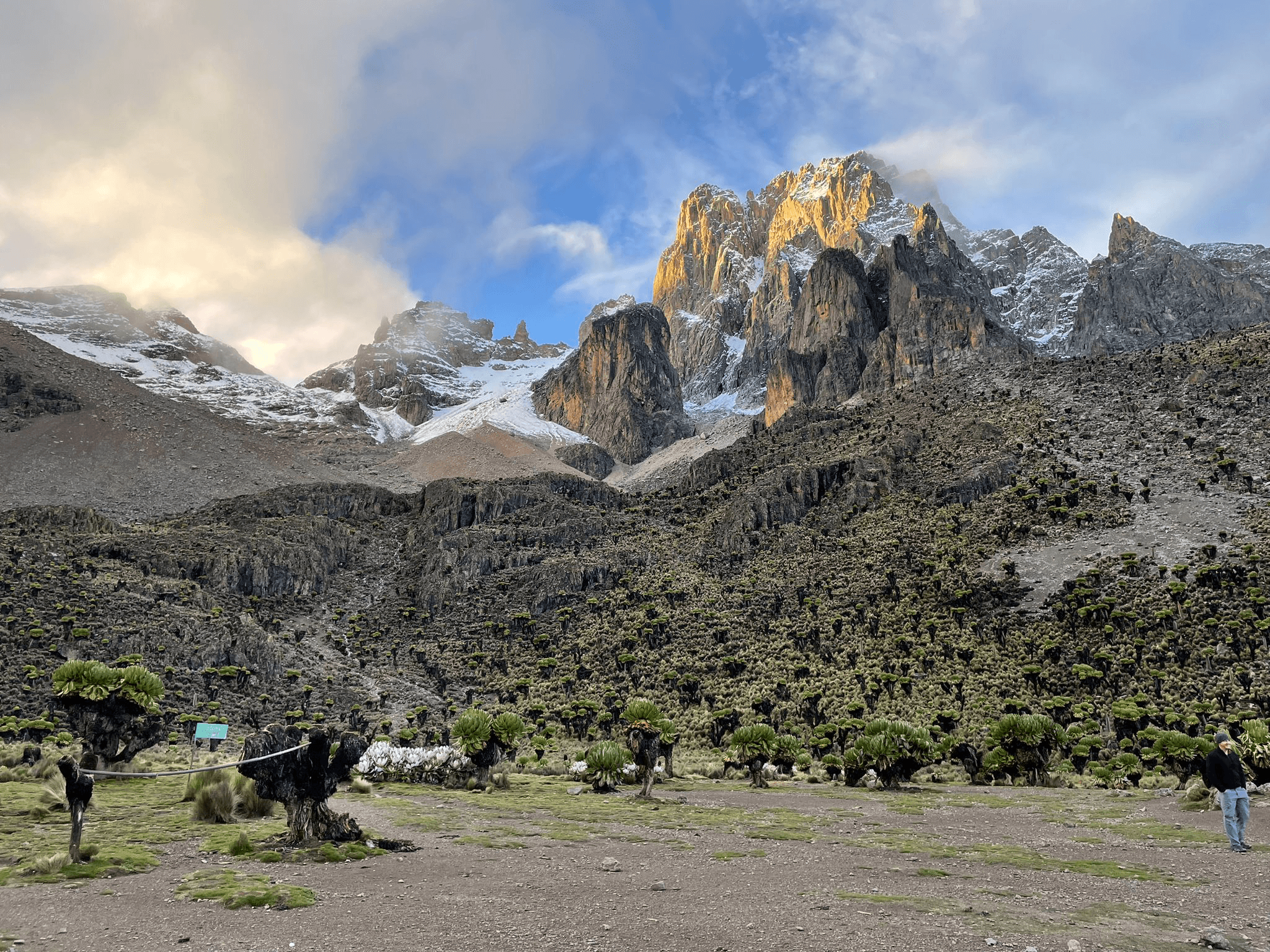
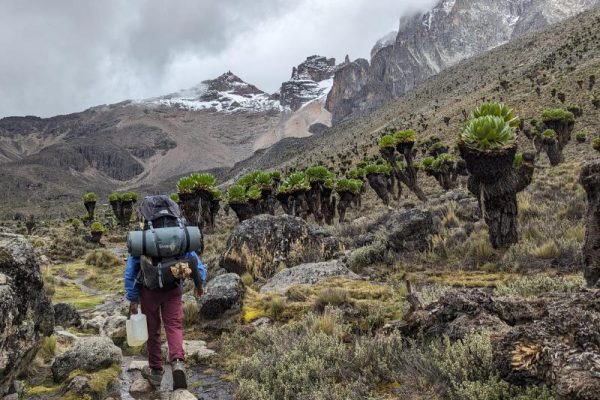
The landscape transitions to heath & moorland, featuring waist-high tussock grasses, mountain sedges and hardy plants adapted to the challenging rocky environment. This zone is known for its unique and colorful plant life which additionally includes giant heathers, “giant rosette plants”, mountain proteas, and several species of lobelia.
Additionally, there exists the Hagenia (Rosewood) species, giant St John’s Wort, with many of the trees festooned with mosses and the lichen Old Man’s Beard.
This heath and moorland zone is home to several wildlife species including the hyrax, bushbuck, bird species such as the olive pigeon and mountain buzzard. You will easily notice the hyrax busking on the rocks during your climb.
This terrain can be steep and rocky, cloud-woodland dominated, with an unpredictable weather.
5. Afro-Alpine Zone (3,800 to 4,800 Meters)
This zone introduces colder temperatures, with rocky terrain and open spaces describe this mountain zone. Characterized by unique rock formations, sparse vegetation and the introduction of ice patches, the Alpine Zone showcases a blend of stone and frost.
While on your climb in this zone, the day time temperatures range from 2°C to 10°C degrees Celsius while night time temperatures fall between -4 to 2 degrees Celsius, receiving an average rainfall of 700–1,000mm.
This zone experiences frequent cloud cover and mist which forms a unique landscape scenery.
Large mammals are rare in the afro-alpine ecosystem. You might still spot the Rock Hyrax, Root-rat, Verreaux’s eagle, Mountain Chat among other species of wildlife.
The Giant Thicket Rat and Mt Kenya Mole Shrew are the only other mammals endemic to the mountain. There are several other small rodents present. Reptiles include the endemic Mt Kenya Bush Viper, the near endemic Alpine Meadow Lizard Adolphus, the Kenyan Side-striped Chameleon, Jackson’s chameleon, and various skinks.
6. Glacial Zone (Above 4,800 to 5,199 Meters)
The Glacial Zone experiences extreme cold, with glacial features dominating the landscape. This zone marks the approach to the summit, where the air is thin, and ice and snow become prominent.
At times this zone is characterised by bare and rocky terrain with little to no vegetation due to the harsh and extreme altitude conditions.
The temperatures here is very cold with frequent strong winds. Day time temperatures can range from -3°C to -5°C, while at night temperatures fall in between -8°C to -15°C. The average rainfall you can expect here is the lowest, at 300–500mm.
If you are a good observer you might still notice a small number of wildlife which have adapted to this extreme mountain environment, while some are just passing by since they cannot stay for long due to the high altitude.
The landscape itself offers unique and breathtaking views of the surrounding peaks and valleys. This area of the mountain is an important source of water for the surrounding areas with several rivers and streams flowing from the melting glaciers and snowfields.
Mount Kenya Weather By Month, Best Time To Climb
Despite its equatorial position, Mount Kenya experiences distinct wet and dry seasons, governed by the movement of the Inter-Tropical Convergence Zone (ITCZ) — a shifting belt of low pressure and rainfall that oscillates north and south around the equator throughout the year. Remember, the rainfall patterns, however, are never completely predictable due to the mountain’s complex topography and frequent formation of orographic clouds (rain clouds formed when moist air rises and cools over the slopes).
Mount Kenya Wet Seasons
Climbing Mount Kenya from March to May:
This period is the main rainy season, characterized by persistent afternoon and evening showers, heavy cloud cover, and occasional thunderstorms. April and May are the wettest months on Mount Kenya Park, particularly on the southeastern slopes.
Trekking Mount Kenya In October to December:
This period marks the arrival of short rains in Mount Kenya which are less intense and shorter in duration but still significant, especially for farmers and trekkers. The Chogoria side receives higher rainfall totals than the Naro Moru or Sirimon slopes.
Mount Kenya Dry Seasons
Hiking Mount Kenya In January & February:
Generally sunny and dry, though the mountain’s summit can still experience frost and occasional flurries.
Mount Kenya Climb from June to September:
This period marks the second dry period in Mount Kenya, often accompanied by crisp mornings, clear skies, and cold nights — ideal for climbing and photography.
Mount Kenya Live Weather Check
Mount Kenya Weather Today
Mount Kenya Live Wind Patterns
Mount Kenya Weather Today
Mount Kenya Equatorial Mountain Climate
Mount Kenya National Park lies almost directly on the equator, yet its weather mirrors that of the world’s great alpine ranges rather than a tropical lowland. Climatologists often refer to this as a “mountain climate island”, where temperature, humidity, and rainfall vary not only by altitude but also by slope orientation and exposure to prevailing winds.
Weather & Climate On Mount Kenya Routes
Climate On Mount Kenya South-Eastern Slopes Of Chogoria
This area receives the highest rainfall — up to 2,500 mm annually.
The area features a lush forest cover, mosses, and permanent rivers dominate.
Clouds form earlier in the day; mornings are often misty.
The area is more prone to heavy rains and slippery trails during wet seasons.
Weather On Mount Kenya North-Western Slopes Of Naro Moru, Sirimon, & Burguret
The areas are drier and sunnier due to rain-shadow effects.
The annual rainfall averages 900–1,500 mm.
The trails are Ideal for trekking during both dry and short-rain periods, as paths remain firmer and clearer.
The nights here are colder due to lower humidity and clearer skies.
Mount Kenya Rainfall Patterns
Divided into three sections, this is the kind of rainfall patterns to expect while hiking Mount Kenya;
Orographic Rainfall: Moist air from the Indian Ocean is forced upward by the mountain, cooling and releasing precipitation.
Afternoon Showers: Even during dry seasons, convective storms may develop after midday due to rapid surface heating.
Persistent Mist: Especially between 2,500–3,500m, cloud forests experience frequent fog that sustains vegetation through “horizontal rainfall”. The moisture deposited directly from clouds onto leaves and moss.
Best Time For Mount Kenya Summit Attempts
Climbers typically plan summit attempts for pre-dawn hours (3:00–6:30 AM), when skies are clearest and winds weakest. By late morning, rising air forms cumulus clouds, reducing visibility and increasing the risk of afternoon storms.
Mount Kenya Astro Night Photography
Above 3,500 meters, Mount Kenya night sky visibility is excellent, with near-zero light pollution, ideal for stargazing and astrophotography.
Mount Kenya Weather Tips for Climbers
Bring sunscreen and sunglasses: UV radiation increases by elevation gain.
Always layer clothing: Temperatures can shift from 25°C at noon to -5°C at night.
Expect daily cloud cycles: Clear mornings and misty afternoons are usual.
Carry rain protection even in “dry” seasons — short showers are common.
Acclimatize properly: Spend at least two nights at mid-altitude camps to adjust to thinner air.
Avoid afternoon ascents: Lightning and sudden downpours are more frequent.
Protect electronics and clothing from moisture: The bamboo and moorland zones retain humidity even when it’s not raining.